
SOLUTIONS · BFSI
The onboarding platform built for the compliance demands of financial services.
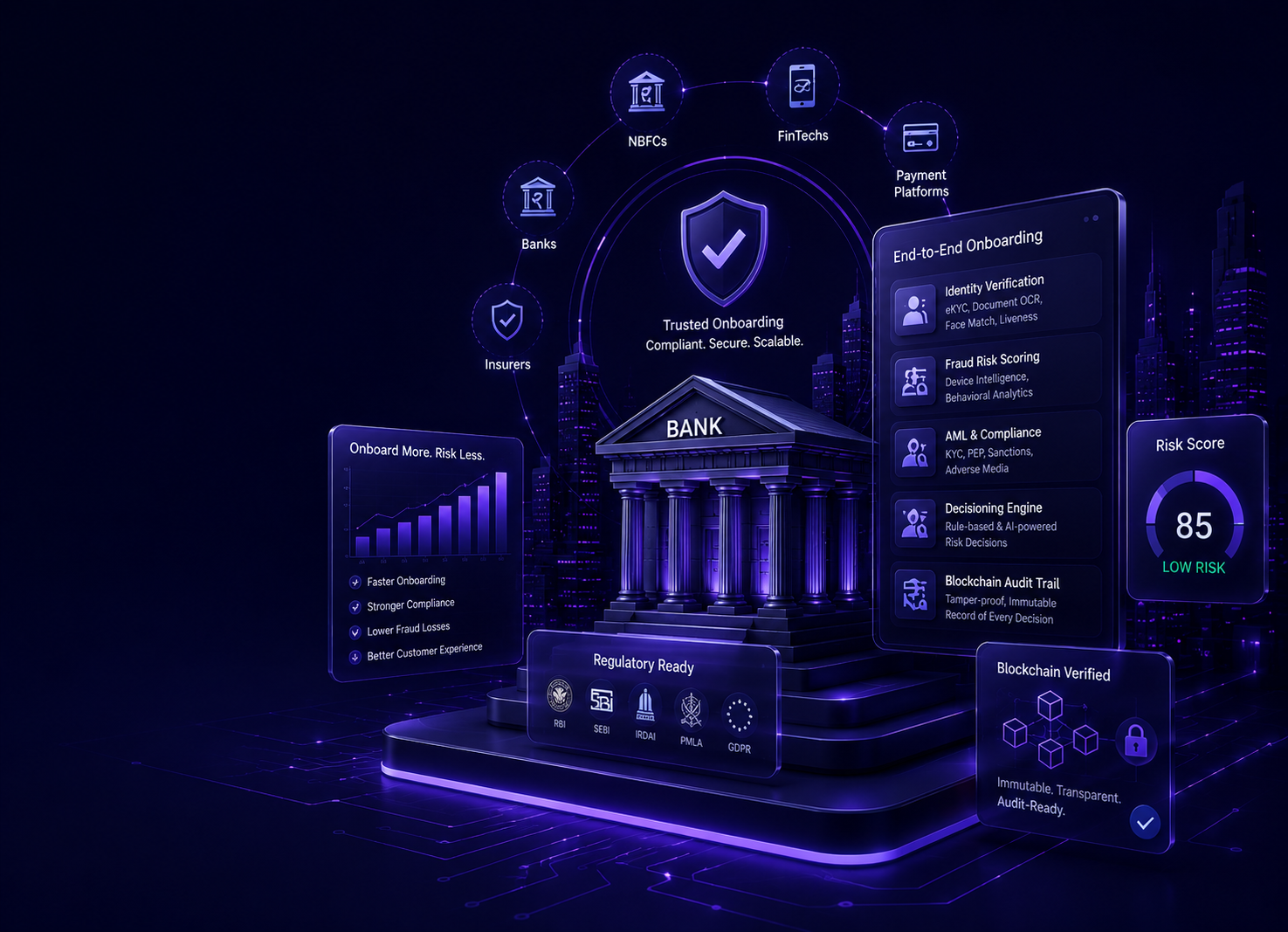
Daksam Analytics gives banks, NBFCs, FinTechs, payment platforms, and insurers one configurable platform to verify customers, satisfy regulators, and generate a blockchain-audited record of every onboarding decision.
THE PROBLEM
Compliance does not stop at identity. Neither does the risk.
Most platforms handle one or two compliance requirements well and leave the rest to manual processes. The documents, the checks, the data residency rules, and the audit trail all have to work together, every time, at scale. In financial services, the gap between what a platform promises and what a regulator expects is where institutions carry risk without knowing it.
THE PLATFORM
Every component your BFSI onboarding needs, in one place.
Daksam Analytics covers the full onboarding journey for financial services institutions. Your compliance team configures which components run, in what order, and to what thresholds, without involving a developer. Below are the platform components most relevant to BFSI onboarding.
WHO IT SERVES
Every BFSI entity that onboards a customer needs verified identity.
OUTCOMES
What financial services institutions see after going live.
FAQ
What BFSI compliance teams ask before they switch platforms.
The platform is configured to support RBI KYC Master Direction for banks and NBFCs in India, CBN KYC Guidelines for Nigeria, and CBUAE regulations for UAE financial institutions. Data residency rules for each jurisdiction are enforced at the infrastructure level. Your compliance team maps the regulatory requirements to the platform configuration without involving a developer. If your institution operates across multiple jurisdictions, each market can have a separate verification flow and data storage policy running on the same platform instance.
Every verification event writes to an immutable blockchain record at the moment it happens. The record captures the document submitted, the checks that ran, the outcome reached, and the exact timestamp. It cannot be edited, deleted, or backdated. When a regulator or auditor requests the record for a specific customer or date range, the platform generates it instantly. There is no manual compilation, no risk of records being altered after the fact, and no gap between what the system did and what the record shows.
Yes. The no-code Workflow Builder is designed for compliance teams, not engineering teams. You can add or remove verification steps, adjust risk thresholds, change the order of checks, and publish the updated workflow the same day. If a regulator issues a new requirement and you need to add a document check or change a liveness threshold before a deadline, your compliance officer does that directly. No development sprint, no ticket queue, no deployment window required.
Data is stored where your regulator requires. Indian institutions store data within Indian infrastructure. Nigerian institutions store data within NDPR-compliant boundaries. UAE institutions store data within UAE infrastructure per CBUAE requirements. The platform supports on-premises deployment, private cloud within your jurisdiction, and hybrid architecture. Data localisation is enforced at the infrastructure level, not written into a policy and relied upon by convention. You can verify the storage configuration before going live and confirm it independently at any point.
Most institutions complete API integration and run their first test verifications within five to ten business days. Daksam Analytics provides hands-on technical support throughout integration at no additional charge. After that, the no-code Workflow Builder means your compliance team can reconfigure and redeploy onboarding journeys without involving a developer. The timeline from signed agreement to live customer verifications is typically two to three weeks, depending on the complexity of your existing systems and the number of verification steps in your initial workflow.
Bring your compliance needs. We’ll show you how Daksam delivers.
Whether you are answering to RBI, CBN, or CBUAE, the demo is built around your regulatory framework. Bring the requirements your current platform is not meeting and we will walk through exactly how Daksam Analytics handles them, live, with your document types already loaded.